


COUNTRY STUDY SERIES: GHANA 2025
STUDY REPORT NO. 15 / JANUARY 31, 2025
POST-ELECTION BLUES: WILL THE NEW PATRIOTIC PARTY (NPP) IMPLODE?
ABSTRACT
Following the shock defeat of the New Patriotic Party (NPP) at the polls on 7th December 2024, several members of the Party, both leading and ordinary, have called for self-examination into the circumstances and factors that contributed to the rather embarrassing performance. The call has prompted the party’s flagbearer and other leaders to announce plans to engage party stakeholders to diagnose the plausible reasons for the electoral collapse and subsequent defeat. The generality of party members, at both branch and regional levels, have also added their voice in accusing the national leadership of gross ineptitude at the strategic and operational levels. Other internal calls for reflection and investigation into the party’s poor performance have also demanded reshuffling of key leaders and total dismantling of the current party structures at all levels, to be replaced by a new vehicle. Despite these calls, there are emergent threats from party foot soldiers to further deal physically with party leaders who may want to stand in their way to rebrand the party for the future.
It would be recalled that the results of the 2024 general elections marked a significant shift in the nation’s political landscape, characterised by the New Patriotic Party’s historic defeat at both the presidential and parliamentary elections. The National Democratic Congress (NDC), led by John Dramani Mahama, who secured the presidency with 6,328,397votes from 267 constituencies, compared to the then incumbent Vice President and Presidential candidate of the New Patriotic Party (NPP), Dr. Mahamudu Bawumia who garnered 4,657,304 votes. Besides the presidential results, the NDC’s victory extended further to clear parliamentary dominance, with the party winning 188 seats and achieving a superior legislative majority[1].
Even though several factors are believed to have contributed to the NPP’s misfortune and downfall at the polls, its inability to maintain its statistical stronghold in the Ashanti and Eastern Regions, which is a crucial voting bloc, as well as loss of representation in five (5) out of sixteen (16) regions signalled a significant erosion of its political base. Among key factors which contributed to the NPP’s defeat include the effectiveness of the NDC’s campaign strategy in using social media in shaping public discourse, coordinated online campaigns led by opposition forces and civil society actors, the NPP’s abysmal governance under President Nana Addo Dankwa Akufo-Addo (a man described as the mother serpent of corruption and a family-and-friends leader). Moreso, the severe economic challenges and hardship faced by many electorates within the country, the abrasive looting of the public purse, impunity and rampant corruption, have all contributed to such massive voter dissatisfaction.
The net effect of the foregoing has left the unanswered question among political watchers and pundits as to what will really happen when the NPP finally gathers to take stock of its defeat, sometime in the first half of 2025. Whether or not there will be a meeting of minds and unity within the party’s rank and file during its internal reform and strategic re-evaluation, or perhaps an interplay of the various forces and factions will lead to internal implosion remain an issue.
The focus of the current study is to resolve the issues posed. It is the intention of the authors to look at the anticipated volatility of NPP politics, as a critical case study in highlighting the dynamic nature of factional behaviour within the party and the importance of responsive leadership in addressing the current concerns facing the totality of party members. The authors take the view that the party’s post-election analysis should be conducted from the polling station level, through the branches, constituencies, regional, and to the national level, and should focus on why leadership accountability, campaign strategy, messaging and measures failed gravely to rebuild trust throughout the support base. Lessons drawn from this painful exercise regarding calls for change in policy and strategy may shape the future trajectory of the NPP and the broader political environment in Ghana. It is our considered opinion that this study will contribute positively to identifying both short to long-term implications for the party’s internal power dynamics and leadership structure.
INTRODUCTION
The New Patriotic Party (NPP) has been one of the two dominant political parties in Ghanaian politics, since the democratisation of the country in 1992. The outcome of the 2024 Ghanaian general elections represents a major shift in the country’s political landscape. The NPP is a centre-right and liberal-conservative political party. Its official slogan is development in freedom, and the party symbol is the elephant. In recent times, the situation within the NPP clearly shows that the party faces several internal challenges which might have contributed to tensions, divisions, and what some analysts term as harbingers to the likely implosion of the party.
Prior to the 2024 elections, and subsequently after the party’s overwhelming defeat, several leaders of the party have discussed such issues, bordering on leadership struggles and succession disputes, shifts in political dynamics, policy disagreements and factionalism, as creating mayhem within the party. The exit and secession of key leaders and members, different factions vying for control, and issues of succession and leadership have all led to in-fighting, internal blame games, tensions and erosion of confidence among ordinary supporters. The failure of the NPP government under President Nana Addo Dankwa Akufo-Addo to deliver key dividends issuing from electoral promises further created a poisoned environment ripe for internal dissatisfaction and disaffection.
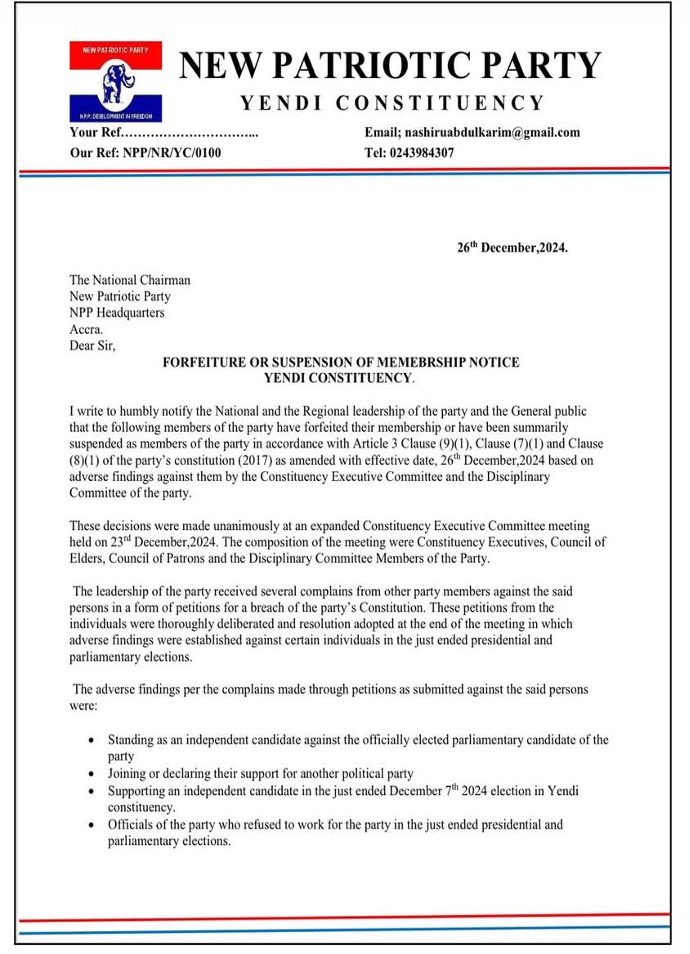
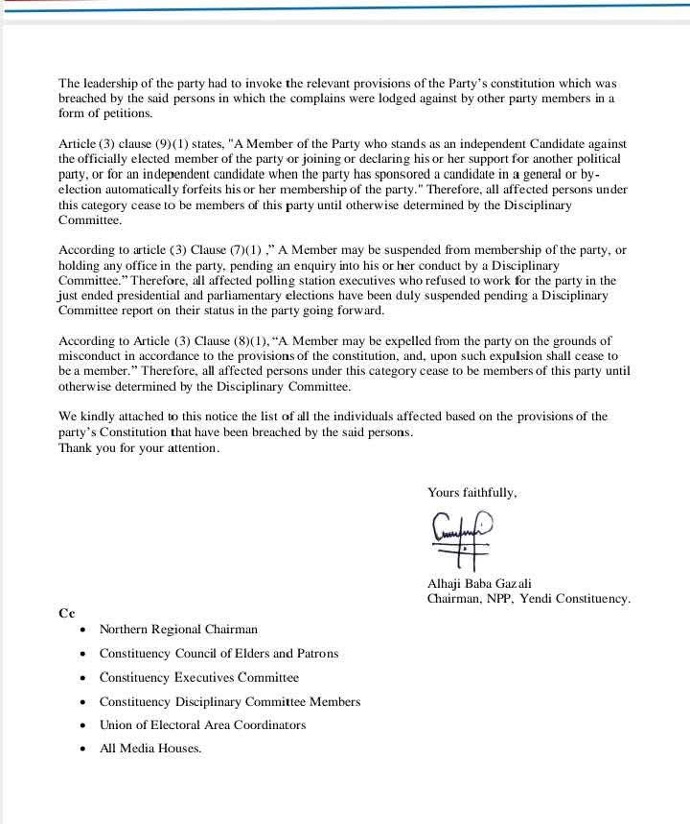
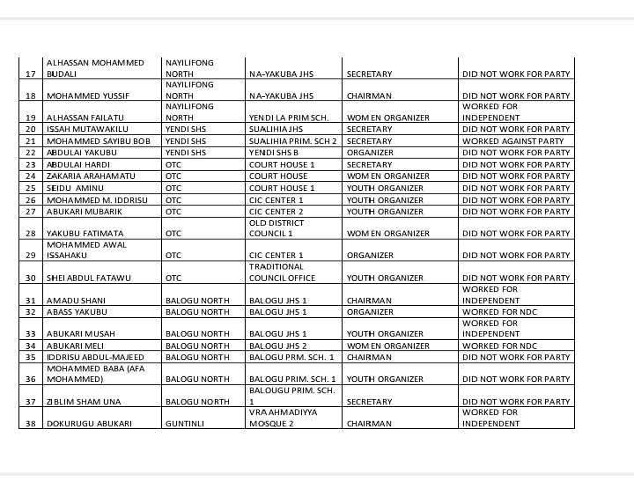
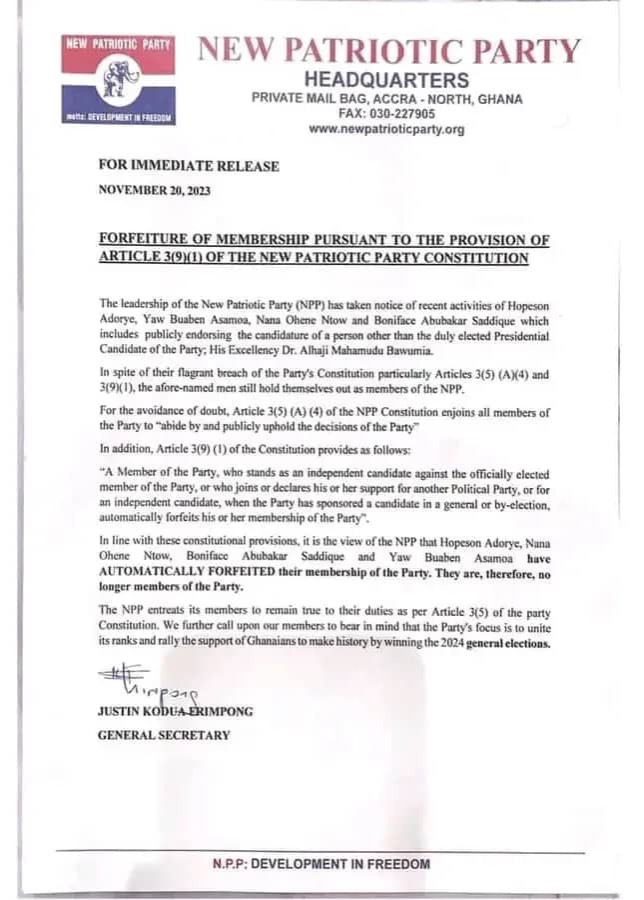
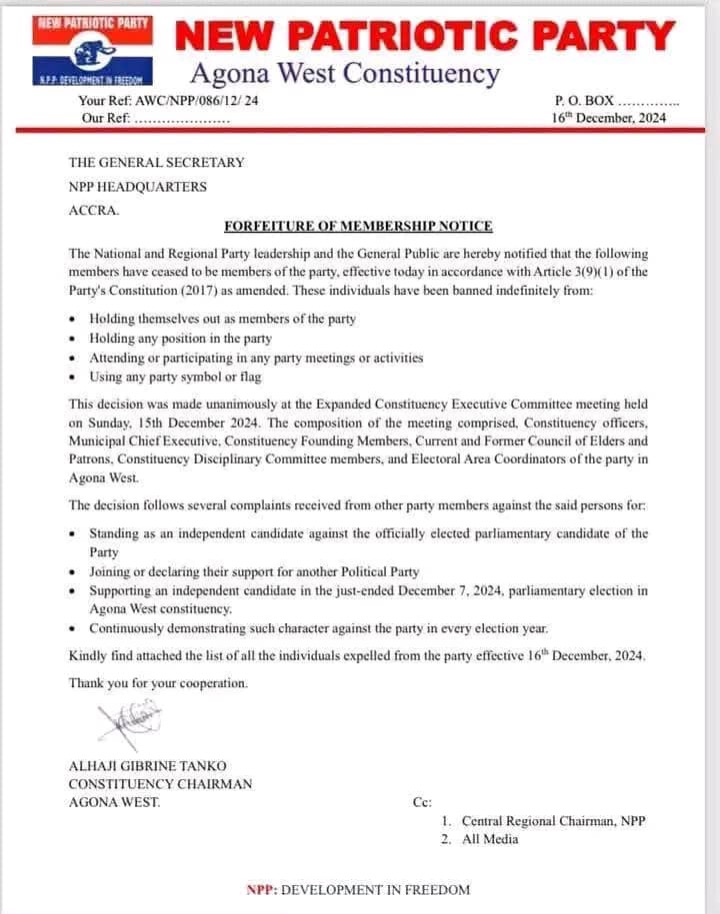
Palpably, the issue has not only become a bitter pill for leadership, it has also affected the grassroot. At the grassroot level, for instance, the forfeiture and/or suspension of leaders and members in some constituencies, such as Yendi and Agona West Constituencies located in Northern and Central Regions, respectively, has doled bitter pills and poisoned the atmosphere for any reconciliation. (See Appendix for some of the releases).
The defeat of the New Patriotic Party (NPP) in both the presidential and parliamentary elections of December 2024, has raised significant questions about the party’s internal cohesion and prospects. The NPP, which had hitherto established itself as a formidable political force in Ghana, faced an unprecedented challenge that exposed weaknesses in its leadership, strategy, and ability to connect with the electorate.
The NPP’s heavy loss of parliamentary seats reflects its weakened grip on certain stronghold regions, such as the Ashanti and Eastern Regions, where the party’s support base has historically been unshakable. The public perception of the NPP as a failing party also contributed to the erosion of support from the electorate, with many floating voters turning to opposition parties that promised change. The erosion of support in these regions was a critical factor in the overall electoral outcome and has since become a focal point for internal party reflection and calls for reform. Moreso, despite its historical successes, this time around the NPP struggled to maintain popular support, especially among the middle class and rural voters. This inability to maintain political dominance, coupled with the party’s defeat in presidential and parliamentary races, has led to loss of faith in the NPP’s leadership, thereby deepening frustrations within the rank and file of the party. Such massive electoral losses have triggered self-examination within the party, leading to internal blame games and the erosion of confidence among ordinary supporters.
This paper addresses the factors that contributed to the NPP’s electoral defeat, the role of internal party divisions, and the likelihood of a party implosion. It also examines the implications of these developments for the broader Ghanaianpolitical landscape. By delving into the root causes of the NPP’s recent defeat, therefore, this essay aims to provide a comprehensive understanding of the party’s internal dynamics and its wider implications for Ghana’s fledglingdemocracy.
HISTORY AND IDEOLOGICAL ORIENTATION OF THE NEW PATRIOTIC PARTY
The New Patriotic Party (NPP) has, arguably, played some significant role in Ghana’s post-independence history. The NPP was birthed in 1992, following Ghana’s return to multi-party democracy, after ten (10) unbroken years of military rule. It was an offshoot of the United Gold Coast Convention (UGCC) formed in 1947, United Party (UP) in 1957, the Progress Party (PP) in 1969, and Popular Front Party (PFP) in 1979. It metamorphosed into the New Patriotic Party in 1992 and has since been a part of the NDC/NPP duopoly that has alternatively governed Ghana, following the country’s return to constitutional democracy.
The NPP’s founding principles could be traced to the ethos of classical liberalism which is heavily weighted in favour of liberal democratic governance, rule of law, free-market policies, private sector-led development[2] and the protection of human rights based upon individual freedoms. The New Patriotic Party (NPP) could thus be described as a centre-right political party. The party has thus adopted “Development in Freedom” as its slogan, and the ‘elephant’ as its emblem. As a typical conservative political party, the NPP’s political and economic interest is promotion the welfare of the bourgeois class, the big rural landowners, traditional rulers and the elites. The party is well organised countrywide, with an organisational structure which includes National and Regional Councils of Elders, National Executive, Regional as well as Constituency Executives, backed by several committees. Among the committees are the Constitutional, Finance, Research, Steering, Organisation, Vetting, and Disciplinary.
THE PARTY AND GOVERNMENT, 2017-2024
GOVERNANCE ISSUES
Public perception of corruption in government did play a crucial role in shaping governance under President Nana Addo Dankwa Akufo-Addo. Accusations of corruption became rampant, particularly following (i) the resignation of the very first appointed Special Prosecutor, Martin Amidu. There were also (ii) the forceful and unjust termination of the appointment of the Auditor-General, Daniel Yao Domelevo; (iii) the persecution of Professor Kwabena Frimpong Boateng, after his revelations on the galamsey[3] menace, which government found distasteful; and (iv) the voluptuous looting of state properties, all gave credence to the allegations of “state capture”.
These revelations of high-profile corruption scandals involving senior government officials and party stalwarts eroded public trust in the NPP’s commitment to good governance and anti-corruption reforms. The Ghana Integrity Initiative (GII) and other civil society groups amplified calls for greater transparency and accountability, but their pleas were largely ignored or dismissed by the ruling party. Investigative journalists and whistleblowers exposed several corruption scandals, including alleged procurement irregularities, the diversion of COVID-19 relief funds, and inflated contract prices for public infrastructure projects.
The NPP’s inability to effectively respond to these allegations further alienated swing voters and disillusioned long-time party loyalists. Rather than addressing public grievances, some NPP officials were seen as dismissive or defensive, compounding the party’s credibility crisis. Public opinion polls conducted by local research firms indicated that corruption was one of the top three issues influencing voter decisions ahead of the 2024 elections. The perception of entrenched corruption within the NPP’s leadership became a potent tool for the NDC, which used it to frame the election as a “referendum on integrity and accountability.”
Then, there was the issue of regionalism and ethnic tensions highlighted by the Akufo-Addo administration. The New Patriotic Party experienced regional and ethnic divides that has influenced its cohesion. There have been instances where certain factions within the party have been heard and seen prioritising specific regions over others, leading to feelings of alienation in some areas of the country. For instance, the former President, Nana Akufo-Addo, was heard, while addressing the people of the Volta region, accusing them of their disinterest in the NPP and so had a choice as to whether offer them help during a national disaster, or not. The erstwhile President’s comments attracted an expected backlash and unpopularity among persons not so identified as Ashantis or Akyems.
Furthermore, the former President was seen commanding traditional leaders or Chiefs in the Northern sector to stand up before they greet him, whereas he curtsied before the ‘king’ of the Ashantis; a gesture most grassroots pronounced unfortunate for a political leader. Another instance is the comment against the well-established leadership record of Ghana’s first President, Dr. Kwame Nkrumah, by the erstwhile Energy Minister, Hon. Mathew Opoku Prempeh, who at the time was the NPP’s Vice Presidential candidate. Such rather derogatory conduct has weakened party unity and its ability to present a unified front.
ECONOMIC HARDSHIP AND PUBLIC DISCONTENT
One of the most cited factors behind the NPP’s defeat is the severe economic crisis that plagued Ghana from 2022 to 2024, decades after the infamous 1983 hunger crisis. During this period, Ghana’s economy experienced significant macroeconomic instability, characterised by rising inflation, which peaked at over 54% in 2023; a depreciating currency that lost more than 50% of its value against the US dollar in 2023 alone; debt defaults and surging food and fuel prices. Households across the country felt the impact of these economic pressures, as the cost of essential goods and services rose sharply, eroding disposable incomes. The Ghanaian cedi lost substantial value against major foreign currencies, making imports more expensive and driving up production costs for local businesses, thereby eroding of confidence in both government and the party.
With Ghana’s national debt reaching alarming levels and a debt-to-GDP ratio exceeding 100% by 2024, the country had to enter an IMF bailout program, which required imposition of further austerity measures[4], such as irritating taxes, like the electronic transfer levy (e-levy) as well as betting taxes, haircuts on investments, and general reduction in public sector spending. Amid the challenges, the government’s handling of the economy became a point of contention and criticism, particularly after the party’s promises of economic transformation were not even halfway realised. The public’s discontent was further fuelled by wage stagnation, job losses, high unemployment rates, particularly among the youth, and the government’s reactive response to economic management dwindled. These economic hardships arguably eroded public confidence[5] in the government and party and created dissatisfaction within the party’s rank and file, leading to disillusionment among members, supporters and sympathisers.
INTERNAL PARTY DIVISION AND FACTIONALISM
President Nana Addo Dankwa Akufo-Addo has been accused by his own party members of running a fascistic administration. Unpopularity with Civil Society, for instance, as well as the party’s increased disconnect with grassroots concerns has aggravated the internal bickering within the NPP. For the rural working people who formed the mass base of the support, the party’s failure to fulfil key campaign promises, such as job creation, better social services, and other economic opportunities was a letdown and betrayal that contributed to the party’s historic downfall[6]. Furthermore, there is internal frustration over a lack of accountability within the party. The failure to address grievances, questions of transparency, and the concentration of power in a few individuals, with such tags as “Akyem mafias”, has alienated some of the party’s key supporters. All these issues, and more, have exacerbated intra-party divisions, making it difficult for the party to move forward cohesively.
This problem follows a saturation of the Akufo-Addo government with arrogant and nonchalant cronies. Key to mention is the faction comprising Gabby Asare Otchere Darko, Asante Bediatuo, Yaw Osafo Marfo, Ursula Owusu, among others. By this action, the President and his team were perceived to be restoring the legacy of his Akyem fathers, disempower the Ashanti cohort’s hold and control of the NPP, while elevating his tribesmen, the Akyems; hence earning the tag ‘the Akyem Mafias’. The consequence of his action is the factional rivalry the country is witnessing today. Thus, there has been a significant factional divide[7] within the NPP, clearly based on regional, ideological, and personal interests. An example remains the separation of Alan Cash and the formation of the Movement for Change. Also, the competition between grassroots and party loyalists of the Movement for Change and the NPP, albeit subtle, has affected unity and togetherness within the party. These factions often manifest as rival groups backing different candidates, and their competition becomes a source of conflict during internal party primaries, elections, and policy decisions.
A palpable point of reference is the assertion by Dr. Nyaho Nyaho Tamakloe, a founding member of the party, who is today exhorted across the party divide for forewarning the party against the character, leadership style and competence to execute policy decisions by the government of Nana Addo Dankwa Akufo-Addo. Thus, ab initio, within the NPP, disagreements over economic policies, party strategies, and how best to approach national issues, have unfortunately received a unanimous endorsement by the leadership. A situation some party folks believe the government has failed to heed to the advice of party leadership. Certain factions within the party are often seen as being more conservative or neoliberal in their economic approach, while others advocate for more populist or progressive policies. These policy rifts have also exacerbated internal conflicts and contributed to a sense of fragmentation within the party. This situation has led many to question the independent leadership potential of the party’s recent flagbearer, Dr. Bawumia.
The absence of a clear succession plan of the party was also problematic and contributed to the cleavage seen at the level of the mass and is creating the uncertainty within the different factions of the elephant party. The selection of Dr. Bawumia as the presidential candidate and Dr. Matthew Opoku Prempeh as the running mate raised concerns about the party’s decision-making process. This arises from the backdrop of notable persons who align themselves with different potential future leaders. A case in point is the dismemberment of the revered Alan Kyeremanten (now the flagbearer and leader of the Movement for Change party) and those who overtly showed their support for Mr. Kyeremanten, among whom were Buabeng Asamoah, Nana Ohene Ntow and Boniface Abubakar Saddique. Of prime import is the political banter between the former flagbearer, Dr. Bawumia, and the venerable Hon. Kennedy Agyapong during the 2024 delegates’ election. This has led to conflicts about who should lead the party in future elections, resulting in divisions and a lack of unity.
ELECTORAL DEFEAT AND FALLOUTS
CONTEXTUALIZING THE 2024 ELECTORAL DEFEAT
The 2024 elections presented a culmination of multiple stressors for the NPP, marking one of the most challenging electoral cycles in the party’s history. The party’s traditional strongholds in the Ashanti and Eastern Regions, which had consistently provided a reliable voter base for the NPP, experienced a significant shift in voter allegiance. Historically, the Ashanti Region has been regarded as the “heartland” of NPP support, consistently delivering high voter turnout and substantial margins of victory. However, in 2024, this stronghold showed signs of fracture as the NPP’s vote share declined significantly. Key constituencies that had been considered “safe seats” for the party were either lost or narrowly retained, signalling a loss of confidence among a section of its core supporters. Similarly, the Eastern Region, another strategic base for the NPP, witnessed unexpected electoral losses. This shift is attributed to growing disillusionment among voters who had once supported the party’s promises of economic stability and development. Analysts suggest that the party’s inability to address pressing local issues, such as infrastructure deficits, youth unemployment, and unfulfilled campaign pledges, contributed to the dwindling support.
Beyond these regional setbacks, the NPP’s overall representation fell in five (5) out of sixteen (16) regions, signalling a drastic erosion of its political support base. Regions that had previously leaned towards the NPP or were considered battleground areas shifted decisively towards the National Democratic Congress (NDC). For instance, the Central Region, which has traditionally been a “swing region,” tilted heavily in favour of the NDC, reflecting a broader national trend of dissatisfaction with the ruling party’s governance. Several underlying factors explain this drastic erosion of support. Economic hardship was one of the most prominent factors, as the Ghanaian economy faced severe challenges from 2022 to 2024. Inflation rates soared, the Ghanaian cedi depreciated sharply against major foreign currencies, and the cost of living escalated. Food prices, transportation costs, and utility bills rose sharply, placing an unbearable financial burden on ordinary citizens. The NPP government’s inability to stabilise the economy and alleviate these hardships left many Ghanaians disillusioned. Middle-class voters, who had previously been stalwart supporters of the NPP’s pro-business policies, began to question the party’s competence in economic management.
Rampant corruption and governance issues further compounded the party’s challenges. Allegations of corruption involving high-profile NPP officials circulated widely on social media and were amplified by civil society organisations and the media. Perceived “state capture” and the misuse of public funds fuelled anger and frustration among voters. The Ghana Integrity Initiative (GII) and other anti-corruption watchdogs released damning reports highlighting the NPP’s failure to curb graft within its administration. Public perception of widespread corruption and the government’s perceived unwillingness to address it significantly eroded voter trust.
The issue of galamsey[8] played a significant role in the NPP’s defeat, when the government of the day was accused of alleged complicity, particularly among its officials. Public protests and grassroots movements pressurised the government to prioritise the fight against galamsey, making it a prominent electoral issue. The more the devastating effects of galamsey persisted, the more the government received severe backlash for its laxity and nonchalance in handling the menace. It raised doubts about political will, governance, and regulatory enforcement of the Akufo-Addo-led administration.
Another factor that played a key role in the NPP’s defeat was the perception of impunity and elitism among ruling elites. The visible lifestyles of government appointees, juxtaposed with the harsh economic realities faced by ordinary citizens, sparked outrage. Citizens expressed frustration with what they perceived as a “disconnect” between the ruling elite and the masses. The failure of the NPP’s leadership to demonstrate empathy and accountability in the face of these grievances alienated large sections of the electorate, particularly young voters, who were vocal on various social media platforms.
These developments created a political environment ripe enough for change. The National Democratic Congress (NDC) capitalised on the NPP’s weaknesses, presenting itself as a viable alternative with a renewed promise of change and accountability. The NDC’s campaign, led by John Dramani Mahama, strategically focused on themes of justice, fairness, and economic revival. The party’s message resonated with a disillusioned electorate that was eager for change, leading to a decisive electoral outcome that saw the NDC secure both the presidency and a parliamentary majority.
ELECTORAL DEFEAT
Among previous electoral defeats which the NPP has experienced, the results from the 2024 general elections are unmatched. As earlier mentioned, the present NPP’s electoral defeat reflects deep-seated divisions and internal power struggles that had been simmering within the party’s structures, since the early 2000s. This internal conflict has been driven by ideological differences, personal ambitions, and divergent strategies on how best to rebuild the party’s image and electoral fortunes. Following the defeat, these divisions have become even more pronounced, as different factions within the party position themselves to influence the direction of future reforms and leadership changes.
One of the most visible sources of factionalism prior to the defeat is the rivalry between supporters of Vice-President and Presidential candidate, Dr. Mahamudu Bawumia, and those who back former Trade and Industry Minister Alan Kyerematen. This divide reflects a broader contest over the ideological and strategic direction of the NPP. Supporters of Dr. Bawumia, who is seen as a modernizer with a technocratic approach to governance, argue that his expertise in economics and finance is essential for the party’s future. On the other hand, loyalists of Alan Kyerematen, a long-time party stalwart with deep roots in NPP’s traditional base, believe that his experience, charisma, and “grassroots appeal” position him as the ideal candidate to restore the party’s fortunes.
The rivalry between these two camps has led to heightened tensions within the party, with public disagreements and veiled attacks becoming commonplace. The divisions are not limited to high-ranking officials but have also permeated the party’s grassroots. Regional and constituency executives have taken sides, often clashing over issues of party strategy, leadership succession, and post-election accountability. This has created an environment of mistrust and fragmentation, weakening the party’s ability to present a united front to the public.
Beyond the Bawumia-Kyerematen rivalry, there are growing calls for a complete overhaul of party leadership at all levels. Grassroots supporters, many of whom felt betrayed by the party’s perceived detachment from their everyday struggles, have been vocal in demanding the resignation of national executives, including the party chairman and general secretary. These calls for change are driven by a belief that the party’s leadership failed to act decisively in addressing the economic hardships, corruption allegations, and public grievances that contributed to the electoral defeat.
FALLOUT – GRASSROOT AGITATION AND POTENTIAL FOR VIOLENCE
The NPP’s electoral defeat has unleashed a wave of grassroots agitation, as disenfranchised party foot soldiers openly express frustration with the party’s leadership. These foot soldiers, who played a vital role in mobilising voters during the election campaign, feel betrayed by what they perceive as a lack of accountability and failure to deliver on promises made by party executives. They have therefore accused the party’s leadership of prioritising personal interests over collective goals, which, in their view, resulted in poor strategic decision-making during the 2024 campaign. For instance, critics argue that the party’s campaign strategy lacked coherence and adaptability, with insufficient emphasis on digital engagement, youth mobilisation, and message refinement. As a result, disillusioned supporters are advocating for a “house-cleaning” exercise to rid the party of what they perceive as complacent and ineffective leaders. While there is no gainsaying that their dissatisfaction is rooted in feelings of neglect, unfulfilled expectations of rewards for their loyalty, and the broader sense of abandonment by the party’s leadership, the intensity and escalation of the agitation are worrisome.
There are reports of threats by party foot soldiers to resort to drastic measures, if their demands for leadership changes are not met. This discontent has been accompanied by instances of open defiance, protest marches, and symbolic acts of rebellion, such as the destruction of party property and the occupation of party offices. The rhetoric of some of these aggrieved supporters has grown and become more militant, raising concerns about the potential for violence and sabotage within the party’s ranks. Political analysts, such as Kwesi Amakye of the University of Ghana, have warned that failure to address these grievances could result in the party’s implosion. Amakye and other analysts note that grassroots discontent is a recurring feature in Ghanaian party politics, particularly after electoral defeats, but the current situation within the NPP appears to be more volatile than usual. The agitation is not limited to ordinary party supporters; it is being fuelled by constituency executives and influential local figures who wield considerable influence within the party’s internal structures.
Several underlying factors contribute to the current grassroots unrest. First, foot soldiers argue that they were promised financial incentives, employment opportunities, and other forms of support as part of their role in campaigning for the party. Many of these promises have reportedly gone unfulfilled, leaving supporters feeling deceived and exploited. Second, there is a perception that party leaders, especially those at the national level, have distanced themselves from the grassroots following the electoral defeat. This perceived detachment has further eroded trust and heightened calls for the resignation or removal of senior party officials. The current agitation has also been fuelled by the ongoing factional rivalry between supporters of Dr. Mahamudu Bawumia and Alan Kyerematen. Foot soldiers aligned with one faction often blame the other for the party’s electoral defeat, thereby intensifying intra-party conflict.
Furthermore, the defeat has prompted discussions about the broader issue of generational change within the party. Younger members and activists have voiced concerns that the “old guard” of the NPP – those who have been in leadership positions for decades – have become disconnected from the changing dynamics of Ghanaian society. Youth factions within the party have called for the infusion of fresh, dynamic, and tech-savvy leaders who can better connect with the younger electorate and adapt to modern campaign trends, such as the use of social media and data-driven strategies.
The potential for violence cannot be underestimated. Ghana’s history of political violence during internal party disputes offers a cautionary tale. Political analysts emphasise that disillusioned and disenfranchised grassroots members, if left unchecked, could engage in acts of sabotage, such as disrupting party meetings, vandalising party offices, or even physically attacking party officials. Already, this factionalism has created a charged atmosphere, where accusations, blame, and scapegoating are rampant. In some cases, these rivalries have escalated into physical altercations at party meetings, constituency gatherings, and branch-level engagements.
There is no doubt the threat of “internal mutiny” would pose a significant challenge to the NPP’s efforts to rebuild and reform after the electoral defeat. To mitigate this threat, party leadership must adopt a proactive approach to conflict resolution. This includes engaging directly with foot soldiers, addressing their grievances in a transparent manner, and providing clear timelines for the fulfilment of campaign promises. Analysts have suggested that party executives should hold regional and constituency forums where foot soldiers can voice their concerns and seek redress.
Additionally, a comprehensive review of party structures, with an emphasis on inclusiveness and accountability, could help restore trust among grassroots supporters. Failure to address these grievances could have long-term consequences for the party, including further fracturing of the party. Disenfranchised supporters could withdraw their support entirely, refuse to participate in future campaigns, or defect to opposition parties. Even more concerning is the risk that internal unrest could escalate into violence and damaging its public image. The NPP’s ability to manage this grassroot agitation will be a litmus test for its capacity to recover from the 2024 electoral defeat and prepare for future elections.
PROSPECTS FOR INTERNAL PARTY REFORM AND WAY FORWARD
RESTRUCTURING PARTY LEADERSHIP
The NPP’s planned post-election review offers a critical opportunity for introspection and restructuring, as there is growing consensus among party members, stakeholders, and civil society actors that comprehensive reforms are necessary to rebuild the party’s credibility, unity, and electoral competitiveness. This review process is expected to serve as a platform for self-assessment, strategic planning, and the redefinition of party priorities in preparation for future elections.
One of the most significant proposals for reform is the restructuring of party leadership at all levels. Calls have been made for changes in the leadership framework, beginning at the polling station level and extending to constituency, regional, and national executive positions, and allowing the grassroots to participate directly in selecting their leaders, through elections. This restructuring aims to eliminate perceived complacency, reward merit-based appointments, and enhance the party’s responsiveness to grassroots concerns.
The rationale for this proposal stems from the belief that some party executives failed to deliver on their mandates during the 2024 election campaign. Critics argue that ineffective leadership at the polling station level contributed to voter apathy and disillusionment, as many grassroots supporters felt neglected and underrepresented. By reshuffling and appointing new, dynamic leaders with a clear vision for the party’s future, through a more inclusive and representative process for selecting leaders[9], the NPP hopes to strengthen its organisational capacity, improve coordination, and ensure greater accountability from the bottom up. Furthermore, the restructuring process is expected to include mechanisms for evaluating the performance of party officials. This will involve the establishment of performance indicators for polling station executives, constituency chairpersons, and regional executives to better connect with the grassroots and address their concerns. Those who fail to meet performance targets could be replaced with more competent leaders, thereby promoting a culture of meritocracy and accountability within the party’s ranks.
ADDRESSING CAMPAIGN STRATEGY DEFICIENCIES, PARTICULARLY THE USE OF DIGITAL PLATFORMS
Another major area of reform will have to focus on addressing deficiencies in the party’s campaign strategy, particularly as the 2024 election exposed significant flaws in the NPP’s campaign approach. While the opposition NDC effectively harnessed social media platforms, such as X, Tik-Tok, and Facebook to shape public discourse and mobilise young voters, the NPP’s reliance on traditional campaign methods, such as physical rallies and face-to-face engagement turned out to be both outdated and less effective.
Moving forward, the NPP should enhance its presence on social media and adopt data-driven campaign techniques to predict voter behaviour and tailor campaign messages. This reform will require the recruitment of skilled digital media strategists who can create engaging content, track public sentiment, and counter opposition narratives in real time. Additionally, to expand its reach, especially among young, tech-savvy voters, local party operatives need to be empowered to run more targeted online campaigns, respond swiftly to misinformation and maintain a consistent presence in digital spaces.
ENHANCING LEADERSHIP ACCOUNTABILITY AND IMPROVING INTERNAL COMMUNICATION
One of the most prominent demands from grassroots supporters and party elders is the need for stronger leadership accountability. This followed from the humiliating defeat at the 2024 polls, which exposed the disconnect between the party’s senior leadership on one part, and its many rank-and-file members and supporters on the other part. To address this issue, the NPP’s reform agenda should include measures to improve internal communication channels and establish mechanisms for leadership accountability. This may involve the introduction of quarterly accountability forums, at the constituency and regional levels, where party leaders could provide updates on their activities, financial management, and strategic plans.
Another key demand from party supporters and grassroots members is the reshuffling of the party’s leadership. Many argue that senior executives who oversaw the NPP’s defeat should be held accountable for their role in the party’s poor performance. This includes calls for the resignation or replacement of executives perceived to have failed in their strategic and operational responsibilities. A “360-degree feedback” system may be introduced, where feedback is solicited from party supporters, members, and stakeholders. This system will provide a comprehensive evaluation of party executives’ performance, enabling the party to identify areas for improvement. Party executives who fail to meet their performance benchmarks could face sanctions, disciplinary action, suspension, or removal from office.
THE ROLE OF CURRENT PARTY LEADERSHIP IN AVOIDING IMPLOSION
Whether the NPP can avoid an internal implosion depends upon the leadership’s ability to decisively manage internal divisions, address knotty grievances, and implement meaningful reforms. One of the biggest challenges that is likely to test the leadership’s endurance and competence will revolve around how to unite the various factions that have emerged within the party. Divisions among followers of Dr. Mahamudu Bawumia, on one side, and supporters of Alan Kyerematen and other party stalwarts, on the other side, have deepened and appeared irreconcilable. As the intractable positions and blame games continue, there are fears that the current untoward situation may escalate into a full-blown crisis within the party, leading to its eventual implosion.
To prevent these divisions from breaking out into the open, party leaders must prioritise consensus-building to restore unity among the rank and file. This process may require party elders and respected figures with moral authority playing key roles in brokering peace and fostering unity, through reconciliation meetings, conflict mediation, and the promotion of a shared vision for the party’s future[10]. In addition to internal dialogue, the NPP’s leadership should launch a rebranding campaign that projects a message of renewal and inclusiveness. By promoting a message of “unity in diversity”, the party can reinforce a sense of shared purpose and motivate members to work together toward common goals.[11]
Finally, to avoid further discontent and ensure buy-in from party members, the NPP’s leadership must present a clear, time-bound roadmap for reforms. This timeline should outline specific milestones for leadership restructuring, campaign strategy overhauls, and internal communication improvements. Transparency in the implementation of reforms will be essential for maintaining the trust and confidence of party members.
LESSONS FROM COMPARATIVE POLITICAL PARTIES IN AFRICA
The challenges currently facing Ghana’s New Patriotic Party (NPP) are not unique. Similar experiences from other political parties in African democracies, such as South Africa’s African National Congress (ANC) and Nigeria’s All Progressives Congress (APC), provide valuable lessons on how to manage internal party strife, leadership transitions, and calls for reform. Both parties experienced a decline in public support owing to delayed responses to corruption allegations, economic challenges, and internal conflicts. Just as in the case of the NPP, both parties faced criticism for being dominated by aging political elites, who were seen as out of touch with the concerns of younger voters. Drawing on these comparative cases, the NPP can identify strategies to avoid internal implosion and rebuild its political relevance.
AFRICAN NATIONAL CONGRESS (ANC) OF SOUTH AFRICA
One key lesson for the NPP from the ANC’s experience is the need for decisive leadership during times of crisis. The ANC’s struggles with internal factionalism and leadership challenges are well known and have been widely documented. It is a common knowledge that the party’s prolonged association with corruption scandals and economic mismanagement has significantly eroded public trust. The factional divide, for instance, between supporters of former President Jacob Zuma and his successor Cyril Ramaphosa, created internal instability that threatened party cohesion. Although President Ramaphosa tried as much as possible in his “new dawn” agenda[12] to remove corrupt officials, promote a message of ethical governance to regain public trust and party cohesion, the ANC got split as the Zuma Faction formed a new political party. The resultant effect led to ANC’s loss of majority support in the last national legislature.
For the NPP, adopting a similar approach could prove beneficial and signal a commitment to reform. But as seen from the ANC’s experience, leadership renewal, characterised by removal of underperforming or controversial executives supported by clear anti-corruption stance cannot by themselves restore credibility among disillusioned supporters and ensure party cohesion.
ALL PROGRESSIVES CONGRESS (APC) OF NIGERIA
Nigeria’s All Progressives Congress provides another valuable case study. The party’s electoral successes in 2015 and 2019 were based on a grand coalition of diverse political factions. However, post-election governance exposed cracks within the coalition, with factions jostling for power and influence. The APC’s ability to remain intact despite these divisions underscores the importance of effective power-sharing arrangements and inclusive decision-making processes. The party’s leadership navigated factional disputes through strategic appointments, dialogue with aggrieved stakeholders, and the creation of internal conflict-resolution mechanisms.
For the NPP, learning from the APC’s experience could inform strategies to manage factional tensions. Proactive conflict resolution processes, such as mediation committees or internal arbitration panels, could provide channels for party members to resolve grievances. Ensuring the inclusion of key factions in leadership roles could also promote a sense of shared ownership and unity within the party.
In summary, there are recurring themes from studying the cases of the ANC and APC. These are the necessity of timely reforms and importance of youth integration in the leadership and structures of the party. Timely action to address grievances, implement leadership changes, and introduce reform initiatives is essential for maintaining party cohesion. Likewise, creating youth advisory councils, appointing young leaders to executive roles, and incorporating youth-friendly policies into the party’s agenda could mobilise the youth vote and strengthen party loyalty.
For the NPP, youth inclusion could be a game-changer, especially with a significant portion of Ghana’s population under the age of 30 years. Delaying reforms could exacerbate internal tensions and further alienate its support base. Immediate steps, such as implementing new leadership election processes, strengthening disciplinary measures, and ensuring transparent financial practices, could prevent the escalation of factional disputes. The sooner the NPP initiates these reforms, the higher the likelihood of restoring party unity and trust.
CONCLUSION
As calls for reform grow louder, the NPP must critically evaluate the type of political organization it seeks to build and become. It must draw on lessons from past reform efforts and electoral defeats to build a more resilient organization. Both the ANC and APC provide cautionary tales about the dangers of factionalism and leadership inertia. Factionalism weakens party structures, undermines unity, and can ultimately lead to electoral defeat. Failure to address factionalism could lead to internal implosion, as seen in other African political parties.
It is in this vein that the NPP’s post-election review represents a pivotal moment in the party’s history. By undertaking reforms, the party hopes to restore its image, rebuild trust with its grassroots supporters, and position itself for future electoral success. Will it transform into a collective body of like-minded individuals dedicated to national development, or risk devolving into an oligarchy or cultic entity that serves the interests of a few?
The success of any bold and comprehensive reform initiative depends on this clarity of purpose for the reform agenda to be coherent and forward-looking. By avoiding haphazard or reactive measures and ensuring that the party serves as a vehicle for public good, rather than private enrichment, will be essential for restoring public trust and internal cohesion. This requires not only an honest appraisal of past mistakes, but also the courage to implement structural changes that may be initially unpopular but ultimately beneficial for the party’s long-term survival.
Key areas of reform should include party leadership reform[13], the establishment of clear guidelines for managing factional disputes, and enhancing campaign strategies through the effective use of digital platforms. If implemented successfully, these reforms could reinvigorate the party’s base, improve its organisational efficiency, and restore its competitiveness in Ghana’s political landscape. Party members are more likely to remain patient and committed if they see clear signs of progress. A published timeline that includes deadlines for key deliverables (such as leadership reshuffles, the establishment of digital campaign units, and internal accountability measures) will keep party members informed and engaged. Failure to meet these deadlines, however, could exacerbate internal discontent and increase the likelihood of factional rifts.
For the NPP to regain its strength and improve its chances in future elections, the review must be objective, transparent, and led by an independent party reform committee to ensure credibility and buy-in from all party stakeholders. Such a move will minimise any implosion of the NPP likely to be attributed to a combination of internal leadership struggles, economic challenges, policy disagreements, factionalism, corruption scandals, and discontent from the grassroots.
[1] This feat surpassed the two-thirds Constitutional requirement for a superior legislative majority. This victory was historic and marked a profound shift in parliamentary power dynamics, which had traditionally been more balanced or tilted in favour of the NPP. The NDC’s parliamentary success is seen as a reflection of broader voter discontent, particularly in regions where the NPP had previously enjoyed strong support.
[2] This is where the role of the state is limited, more or less, to creating an enabling environment for private enterprise and entrepreneurship to flourish. Policies might include unbridled privatisation of state-owned enterprises, reducing state intervention in the economy, and promoting economic liberalisation.
[3] illegal mining
[4] These measures were highly unpopular, particularly with the working class and pensioners.
[5] Recent research by the Institute for Fiscal Studies (IFS) highlighted how economic hardship often correlates with electoral outcomes in Ghana. Historically, Ghanaian voters have demonstrated a tendency to punish incumbent governments during periods of economic downturns. The economic hardships experienced in 2024 created fertile ground for opposition parties, especially the NDC, to campaign on the promise of economic revival. The NDC’s messaging, which focused on “relief, recovery, and restoration,” resonated deeply with a population that had become frustrated with the NPP’s perceived economic mismanagement.
[6] The party’s leadership, especially under Nana Addo and his bourgeois cohorts (including Otchere Darko, Bediatuo), is more focused on urban elites and connected political insiders, rather than addressing the ordinary concerns of party members. Consequently, the elephant party has tremendously lost popular support.
[7] Factionalism within the NPP has not only led to internal bickering but has also created the risk of a potential party split. Disaffected members, particularly those aligned with Alan Kyerematen’s camp, have hinted at the possibility of forming a breakaway party, if their calls for reform and leadership change are not heeded. This possibility poses a significant threat to the NPP’s future unity and electoral viability.
[8] President Akufo-Addo himself, during his last State of the Nation Address (SONA) to Parliament, on January 3,
2025, attributed the NDC’s flawless victory to the issue of galamsey.
[9] As part of this initiative, Boakye Agyarko – a senior member of the NPP – in a reflection wrote “it is imperative to approach this moment of reckoning with caution and deliberation. A significant lesson from the party’s history, particularly from the reform efforts of 2009, underscores the dangers of consolidating power in the hands of a single individual. This ‘Caesar-like’ centralization of authority risks reducing the party to a personality cult, sidelining collective wisdom, and alienating grassroots supporters. The reform agenda should prioritize establishing systems that safeguard against the concentration of power in one individual or faction, thereby fostering a party structure that is inclusive and democratic”.
[10] Chairman Wontumi’s call for stakeholder engagement is widely seen as a positive first step toward fostering unity and promoting dialogue within the party. His proposal aims to bring together key party stakeholders, including national and regional executives, grassroots representatives, party elders, and civil society actors. The goal is to create a platform for open discussion, where grievances can be aired and solutions proposed.
[11] However, while stakeholder engagement is a constructive starting point, critics argue that mere dialogue is insufficient to resolve the deep-seated issues plaguing the party. Skeptics contend that past stakeholder engagements have often resulted in superficial agreements without substantive follow-through. To ensure that the current process yields meaningful outcomes, party leaders must approach it with a commitment to transparency, active listening, and a willingness to make difficult decisions.
[12] The New Dawn Agenda emphasized leadership renewal, anti-corruption measures, and party-wide accountability.
[13] Effective leadership reshuffles may involve appointing competent, reform-minded, individuals to key positions at the polling station, constituency, regional, and national levels. Such changes would signal a commitment to renewal and provide a fresh impetus for party mobilisation. This includes instituting leadership performance audit to remove ineffective leaders and appoint competent and forward-thinking individuals to key roles and defining roles for party elders, forming reconciliation committees, and holding transparent leadership elections to restore member confidence. The audit should aim to identify leadership gaps, highlight areas for improvement, and establish clear benchmarks for party officials.
REFERENCES
- Institute for Fiscal Studies (2024). “Ghana’s Economic Outlook and Electoral Behaviour.”
- Ghana Integrity Initiative (2024). “Corruption Perception Report 2024.”
- Amakye, K. (2024). “Factionalism and the Politics of Reform in Ghana’s NPP.”
- Political Analysis Journal (2024). “The Role of Digital Media in Shaping Ghana’s Electoral Outcomes.”
- Ghana Electoral Commission (2024). “2024 General Election Results.”
- https://newpatrioticparty.org/about/
- Canada: Immigration and Refugee Board of Canada, Ghana: New Patriotic Party (NPP), including origin, structure, leadership and membership; treatment of NPP members by authorities (2011-November 2013), 5 December 2013, GHA104685.E available at: https://www.refworld.org/docid/542951a44.html [accessed 19 May 2023]
- https://www.modernghana.com/news/1366542/the-npps-bitter-pill-navigating-post-election.html
- https://www.theafricareport.com/329073/ghana-ruling-npp-purges-rebels-who-back-wrong-presidential-candidate/
- https://www.theafricareport.com/353685/ghana-feud-in-bawumias-walewale-backyard-exposes-cracks-in-ruling-npp/
- https://youtu.be/UxQsGuHoKIU
- https://phoenix-browser.com/Bk0y320B8Xv
- https://phoenix-browser.com/K4Um0o2c9k
- ‘Young Elephants probe NPP’s Defeat’, The Ghanaian Publisher, pg. 03, Monday, 13th January, 2025.
- ‘I will Expose All Appointees of Akufo-Addo Who Stole Our Money – Hopeson Adorye, The Insight, pg. 9, Monday 13th January 2025.
List of Abbreviations/Acronyms
| Abbreviation | Meaning | Remarks | |
| ANC | African National Congress | a leading political party in South Africa. | |
| APC | All Progressives Congress | a leading political party in Nigeria. | |
| GDP | Gross Domestic Product | ||
| GII | Ghana Integrity Initiative | a civil society group. | |
| IFS | Institute for Fiscal Studies | a civil society group | |
| NDC | National Democratic Congress | formed in 1992 by the PNDC | |
| NPP | New Patriotic Party | birthed in 1992. | |
| PFP | Popular Front Party | formed in 1979 by some members of the Progress Party | |
| PP | Progress Party | successor to the United Party | |
| SONA | State of the Nation Address | ||
| UGCC | United Gold Coast Convention | foundation party of the NPP, formed in 1947 | |
| UP | United Party | base party of the NPP formed in 1957. |



Также рекомендую вам почитать по теме – https://www.1cpp.ru/forum/YaBB.pl?num=1765652842/0#0 .
И еще вот – http://devichnik.su/forum/72-27695-1 .
Join our affiliate program today and start earning up to 30% commission—sign up now!