By Kekeli Sir pallic
Within the capitalist world-economy, hegemonic transitions are, according to world-systems theory, a recurring feature rather than an anomaly. In this framework, hegemony denotes more than raw dominance: it signifies a state’s simultaneous superiority across the productive, commercial, and financial spheres of the global economy, enabling it to organize the world-system in its own interests.
The question this piece asks is a live one, not a settled one: is United States hegemony declining, or is this the latest in a long line of premature obituaries for American power? To answer it honestly, two things must be true. First, the case for decline must be presented on its strongest terms, using the same analytical lens that explains Britain’s fall from hegemony a century ago. Second, the case of the decline must be weighed against the counterevidence.
This piece works through both, then states where the balance of evidence points and what would change that judgment.
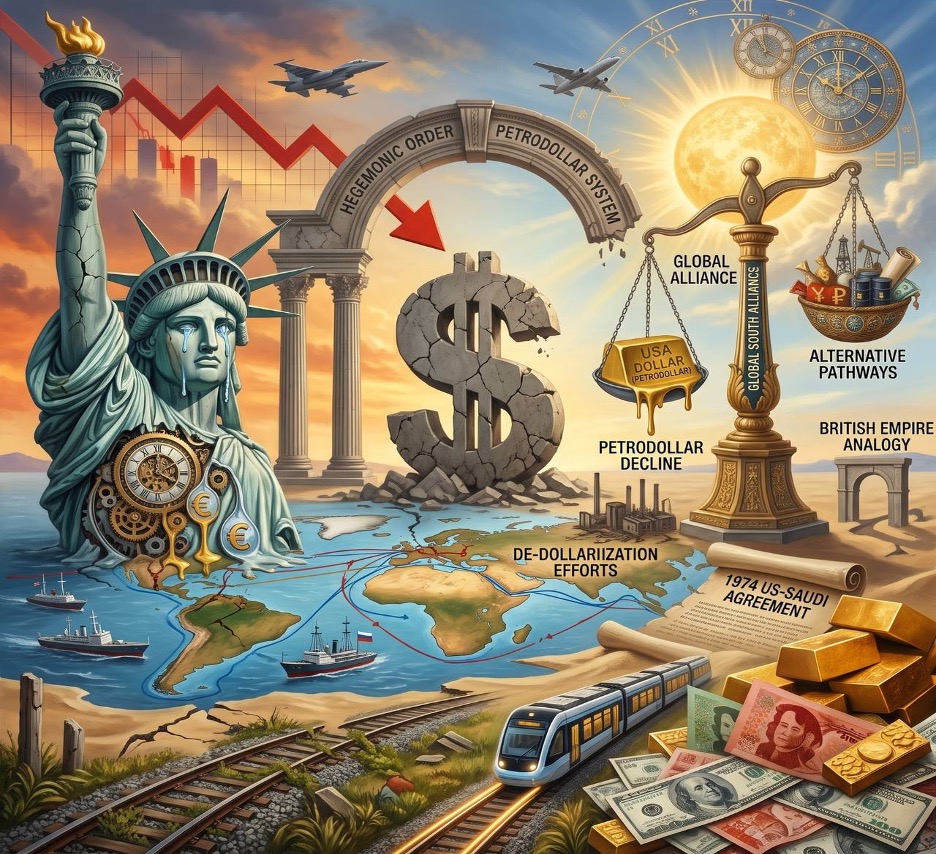
The financial bedrock of US global power is the petrodollar system: a strategic arrangement forged in a moment of acute economic crisis that created permanent global demand for the dollar and secured its position as the world’s premier reserve currency. This arrangement stabilized the US economy, funded its military expansion, and allowed it to consume more than it produced for five decades.
In July 1974, the United States and Saudi Arabia reached an agreement that reshaped the global financial order, parts of which remained undisclosed for over four decades. Washington committed to the long-term survival of the House of Saud, including advanced military hardware and an implicit guarantee of intervention against external threats. In exchange, Saudi Arabia used its position within OPEC to ensure that oil sales worldwide were priced exclusively in dollars, meaning any nation wishing to buy oil first had to acquire dollars.
The resulting loop was closed and self-reinforcing: oil-exporting nations accumulated dollar profits, which were then substantially reinvested in US Treasury bonds, meaning American oil consumption was effectively financed by the oil producers themselves.
World-systems analysis treats hegemonic erosion as a sequential process, and Britain’s experience in the late nineteenth and early twentieth centuries offers a direct analogy to the challenges facing the United States today. British decline unfolded in three stages. Britain was the “workshop of the world” for much of the nineteenth century, but its failure to fully adopt second-industrial-revolution innovations in chemicals, steel, and electricity allowed the United States and a newly unified Germany to catch up and surpass Britain’s industrial output. As Britain’s productive edge eroded, so did its share of global commerce, as competitors turned to protectionist measures. Capital that once flowed into domestic manufacturing was redirected into financial services and overseas investment: financialization, the final phase of British economic dominance, in which the City of London remained a financial centre even as the country’s material foundations crumbled.
This erosion transformed a stable, unicentric world order into a multicentric one marked by escalating rivalry, a colonial scramble, and a military buildup, culminating in what some historians call a new Thirty Years’ War (1914 to 1945), which exhausted Britain and its European rivals and confirmed the transfer of hegemonic power to the United States.
Just as Britain was once the workshop of the world, the United States in the post-war era became the undisputed centre of mass production. That relative position has eroded for decades amid global competition. The productivity gap between the US and its primary competitors has narrowed considerably, and the rise of the European Union, Japan’s post-war recovery, and, above all, China’s emergence as a manufacturing power.
The US economy has, on this account, followed the same trajectory as Britain’s: as its manufacturing base has been challenged, capital and policy attention have shifted toward financial services, the characteristic third stage of hegemonic decline. This trend is compounded by the national debt, which, according to mid-2024 figures, exceeded 35 trillion dollars. Theories that a currency-issuing state is immune to fiscal limits suggested the world’s reserve-currency issuer could never face a genuine debt constraint. As the Federal Reserve raised interest rates to combat inflation, debt-servicing costs rose sharply enough to threaten crowding out other discretionary spending, thereby exposing structural fragility.
The petrodollar system faces its most coordinated challenge since its inception, driven by a convergence of interests throughout the Global South.
This is not strange since the US has weaponized the dollar on different accounts. The 2022 freezing of Russia’s foreign currency reserves by the US and its vassals for example signalled to other holders of dollar reserves that those assets are not unconditionally secure private property. This damaged the dollar’s reputation as a neutral store of value and accelerated the search for alternatives among nations, including China and Saudi Arabia.
A parallel payment architecture has been developed as a mechanism against this weaponization of the dollar. Russia’s System for Transfer of Financial Messages has been linked to China’s Cross-Border Interbank Payment System (CIPS), creating a channel for trade outside Western-controlled infrastructure. An alternative market for oil has emerged, with Russia selling substantial volumes to India and China in yuan, rupees, and dirhams.
The petroyuan is also another mechanism. China’s yuan-denominated crude oil futures contract on the Shanghai International Energy Exchange allows producers to convert yuan holdings directly into physical gold, substituting the trust deficit of a fiat currency with the tangibility of a hard asset. This incentive is aimed squarely at major oil producers weighing the risk of holding revocable dollar assets.
As a hegemon’s economic and financial power wanes, it has historically relied more heavily on residual military supremacy. For decades, the US used military intervention against smaller states that sought to circumvent the dollar’s monopoly over oil pricing. Three cases illustrate this pattern.
In November 2000, Saddam Hussein’s government switched Iraq’s oil sales from dollars to euros. As the euro appreciated over the next two years, Iraq benefited, and speculation grew about a broader OPEC shift. By August 2002, the Bush administration’s focus had shifted toward regime change in Iraq, and after the 2003 invasion, one of the American occupation authority’s first economic decisions was to switch Iraqi oil sales back to dollars.
Muammar Gaddafi was developing a plan for a gold-backed pan-African currency to facilitate oil and resource sales. Some subsequent analyses have linked this plan to the NATO-led intervention that removed him from power.
Hugo Chávez and later Nicolás Maduro pursued efforts to reduce the country’s dependence on the dollar-dominated financial system and proposals for a Latin American currency union, alongside deepening ties with Russia, China, and Iran. The United States responded with sanctions targeting Venezuela’s oil exports, financial access, and foreign assets, with the explicit goal of inducing economic collapse and regime change. Venezuela’s sovereign gold reserves became subject to seizure and prolonged legal disputes, and the country’s economy fragmented into sanctioned and illicit parallel systems. On 3 January 2026, US forces captured Maduro in a large-scale military operation. He was then flown out of the country and charged in the Southern District of New York with narco-terrorism, cocaine trafficking, and weapons offenses.
Military intervention worked against isolated states like Iraq and Libya, but this approach becomes far more dangerous when facing peer or near-peer competitors. The current de-dollarization effort is not led by a single vulnerable leader but by a coordinated bloc that includes nuclear-armed Russia and China’s economic weight.
Before concluding that the pattern above amounts to decline, the counterevidence deserves an equally serious hearing.
Reserve currency dominance has eroded slowly, not collapsed. The dollar’s share of official global foreign exchange reserves stood at roughly 57 percent in the first quarter of 2026, according to IMF Currency Composition of Official Foreign Exchange Reserves (COFER) data, down from around 71 percent in 2000. The decline has run across two and a half decades, not a rupture. The dollar and euro together still account for more than three quarters of global reserves.
The dollar’s grip on transactions and trade invoicing remains largely unchallenged. Bank for International Settlements data from its 2025 Triennial Survey put the dollar’s share of global foreign exchange turnover at 89 percent and its share of global export invoicing at about 54 percent.
The parallel system remains structurally dependent on the one it is meant to bypass. CIPS transaction volumes have occasionally exceeded SWIFT’s single-day throughput, but CIPS still relies on SWIFT’s messaging infrastructure for most of its transactions and connects a few thousand institutions, compared with SWIFT’s more than eleven thousand across over two hundred countries. This looks more like a sanctions-resistant channel layered on the dollar system than a genuine rival to it, at least for now.
This is not the first predictions of US decline, after Vietnam in the 1970s, again during Japan’s economic rise in the 1980s, and again after the 2008 financial crisis. Each time, the dollar-centred system proved more durable than expected.
The petrodollar erosion documented is real and measurable, not speculative. Reserve share has fallen by twelve percentage points since 2000. De-dollarization infrastructure that did not exist twenty years ago now exists. The debt and financialization pressures are concrete, not rhetorical. On the other hand, the dollar still clears most of the world’s trade and reserves, and the alternatives, while growing quickly in percentage terms, remain a fraction of the system they are meant to replace in absolute terms.
So, is US hegemony really on a Downward Elevator?